

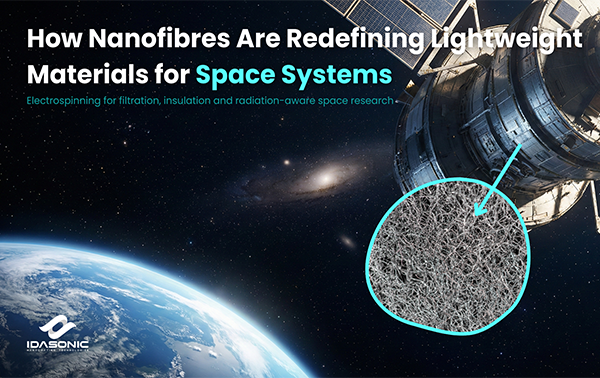
The rapid evolution of space technologies has intensified the demand for advanced materials that combine lightweight design, functional performance, and long-term reliability under extreme conditions. Spacecraft systems, particularly those operating in low Earth orbit or deep space missions, are exposed to severe thermal fluctuations, radiation, and confined operational environments. As a result, conventional material solutions are increasingly insufficient to meet emerging performance requirements.
Electrospinning technology has gained significant attention in space-related research due to its ability to produce nanofibrous structures with precisely controlled morphology and functionality. By enabling the fabrication of ultra-light, high-surface-area materials, electrospinning offers new opportunities for material innovation in space systems.
Electrospinning is a fiber production technique that utilises electrostatic forces to create continuous fibres with diameters ranging from the micro- to the nanometre scale. This process allows researchers to tailor fibre diameter, porosity, and layer architecture with a level of control that is difficult to achieve using traditional manufacturing methods.
For space applications, such architectural control is particularly valuable. Reducing structural mass while maintaining or improving performance is a fundamental objective in spacecraft design. Electrospun nanofibre networks provide a unique balance between mechanical efficiency and functional adaptability, making them suitable for a wide range of space-grade material systems.
One of the most promising application areas for electrospinning in space technologies is filtration within environmental control and life support systems (ECLSS). Crewed spacecraft rely on closed-loop systems for air and water management, where filtration efficiency and system reliability are critical for mission safety.
Electrospun membranes offer high filtration performance due to their interconnected pore structures and high surface area. These characteristics enable efficient removal of particulates, contaminants, and microorganisms while maintaining low airflow resistance. Compared to conventional filter media, nanofibrous membranes can achieve improved separation efficiency with reduced material thickness and weight.
Such advantages position electrospinning as a key research platform for developing next-generation filtration materials for long-duration space missions.
Thermal control is another major challenge in spacecraft engineering. Space systems are subjected to extreme temperature gradients caused by alternating exposure to solar radiation and deep-space cold environments. At the same time, ionising radiation poses long-term risks to both materials and onboard electronics.
Electrospun nanofibrous materials can be engineered into multi-layer insulation systems that limit heat transfer through controlled porosity and fibre orientation. Their low density makes them particularly attractive for applications where mass reduction is critical. Additionally, electrospun polymer-based nanocomposites are increasingly explored for radiation attenuation, offering a lightweight alternative to conventional shielding materials.
As space missions become longer and more complex, the demand for multifunctional and adaptive materials will continue to grow. Electrospinning is well positioned to support this transition by enabling the design of materials that integrate filtration, insulation, and protective functions within a single lightweight architecture.
Rather than serving as a standalone manufacturing technique, electrospinning should be viewed as a flexible R&D platform for space-grade material development, supporting both fundamental research and early-stage prototyping.
Electrospinning technology offers significant advantages for space applications, particularly in the areas of filtration, thermal management, and radiation mitigation. Its ability to produce ultra-light, highly functional nanofibrous materials makes it a valuable enabling tool for advanced space research and development.

For company news, product updates and releases, subscribe to our newsletter.
© 2016 IDASONIC: Ultrasonic Spray Coating & Electrospinning Systems
Privacy Policy – Terms and Conditions – Cookie Declaration