
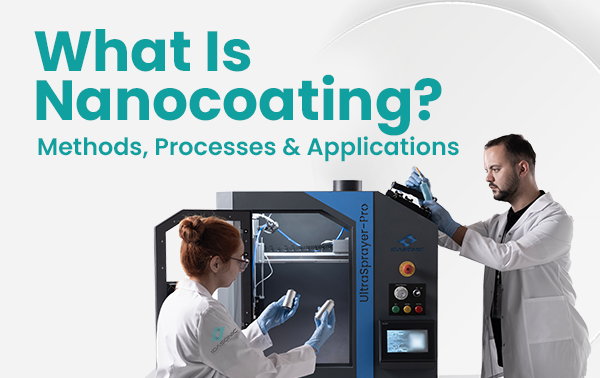

From surface preparation to functional thin films: understanding how nanocoating technologies are used in advanced manufacturing.
A material’s performance is not determined solely by what it is made of. In many applications, what happens at its surface can be just as important.
The surface of a fuel cell component, the active layer of a solar cell, or the coating on a medical device can influence how the entire product performs.
This is where nanocoating technology becomes relevant.
Nanocoating is the process of creating a thin, functional coating whose thickness, structure, or engineered features are controlled at the nanometer scale. Depending on the material and application, nanocoatings can modify surface properties such as wettability, electrical conductivity, chemical resistance, optical behavior, and interaction with biological environments.
A nanometer is one-billionth of a meter. Yet the significance of nanocoating goes beyond making a layer extremely thin. The real challenge lies in controlling how the coating material is distributed, how it interacts with the substrate, and how consistently the desired surface properties can be reproduced.
For researchers and manufacturers, achieving these results requires more than selecting the right formulation. The deposition method, surface preparation, and process parameters all play essential roles.
There is no single method for applying a nanocoating. The appropriate technique depends on the substrate, coating material, target thickness, required surface characteristics, and production scale.
A typical nanocoating process involves several stages:
1. Substrate preparation
The surface is cleaned and, when necessary, modified to support coating adhesion and uniform spreading.
2. Coating material preparation
The functional material is prepared in a suitable form, such as a solution, suspension, dispersion, or polymer formulation.
3. Deposition or fiber formation
The selected technology distributes the material across the substrate or creates a functional structure on its surface.
4. Drying, curing, or post-treatment
Depending on the formulation, the deposited material may require solvent evaporation, thermal treatment, chemical curing, or another consolidation process.
5. Characterization and validation
The resulting coating is evaluated for properties such as thickness, uniformity, adhesion, morphology, and application-specific performance.
These stages may appear straightforward, but small variations in process conditions can substantially influence the final result.
This is one reason why controlled deposition technologies have become increasingly important in advanced materials research and industrial manufacturing.
Among solution-based coating technologies, ultrasonic spray coating offers a flexible approach to depositing functional materials.
Unlike conventional spray methods that primarily rely on pressure to break a liquid into droplets, ultrasonic atomization uses high-frequency mechanical vibrations to generate a fine mist.
The atomized liquid is then directed toward the substrate, where droplets deposit and form a coating as the solvent evaporates.
What makes ultrasonic spray coating useful?
Its principal advantage is the ability to control several parameters involved in the deposition process.
Liquid flow rate, nozzle movement, substrate temperature, spray pattern, and atomization conditions can be adjusted according to the coating material and desired film characteristics.
With an appropriately developed process, ultrasonic spray coating can support:
Uniform thin-film deposition
Controlled delivery of coating material
Repeatable coating processes
Reduced overspray and material waste
Deposition of functional solutions and suspensions
Process development from laboratory research toward larger-scale production
The technology is relevant to a wide range of applications, including solar cells, fuel cells, battery components, electronic devices, functional membranes, and biomedical coatings.
However, ultrasonic atomization does not automatically guarantee a nanoscale film or uniform coating. Final film quality depends on formulation properties, droplet behavior, substrate conditions, drying dynamics, and process optimization.
For example, in energy applications, the uniformity of functional layers can directly affect charge transport, electrochemical activity, and overall device performance.
This is why the deposition process must be developed around the material and its intended function rather than treated as a simple spraying operation.
Even a carefully optimized coating formulation may perform poorly if the substrate surface is not properly prepared.
Some polymers and other low-surface-energy materials are difficult to wet. A liquid coating may spread unevenly, retract into droplets, or form defects during deposition.
Plasma surface treatment provides a way to modify these surface characteristics.
Plasma is a partially ionized gas containing reactive species capable of interacting with a material’s surface.
Depending on the process gas, operating conditions, and substrate, plasma treatment can clean surfaces, introduce functional chemical groups, and change surface energy.
These modifications can improve wettability and, in suitable material systems, promote coating adhesion.
Why combine plasma treatment with ultrasonic spray coating?
Because successful coating is not only about depositing material. It is also about ensuring that the material interacts with the substrate as intended.
Consider a polymer substrate with limited surface wettability. Applying a liquid coating directly may result in inconsistent spreading.
A suitably designed plasma pretreatment step can increase the surface’s affinity for the coating formulation, helping it spread more evenly.
Ultrasonic spray coating can then be used to deposit the functional layer under controlled conditions.
This combination can be particularly valuable in electronics, membrane technologies, medical devices, and polymer-based components.
It is important to distinguish plasma surface treatment from plasma-based coating deposition. Conventional plasma pretreatment primarily modifies the existing surface; it does not necessarily deposit a new film.
In short, plasma treatment prepares the surface, while ultrasonic spray coating deposits the functional material.
Not every functional surface requires a continuous thin film.
In some applications, the objective is to create a porous structure with a high surface-area-to-volume ratio.
This is where electrospinning becomes particularly relevant.
Electrospinning uses an electric field to draw fine fibers from a polymer solution or melt. Under appropriate conditions, the resulting fibers can have diameters in the nanometer range.
As these fibers accumulate, they form a nonwoven network with characteristics that differ considerably from those of a conventional coating film.
Electrospun structures can offer high porosity, tunable fiber morphology, and a large accessible surface area.
These properties make electrospinning useful in fields such as:
Filtration and separation membranes
Tissue engineering research
Wound dressing materials
Battery separators
Functional textiles
Sensors and advanced composite materials
Electrospinning and ultrasonic spray coating should not be considered interchangeable technologies.
Ultrasonic spray coating is generally used to deposit liquid-based materials as thin layers, while electrospinning is used to create fibrous structures.
The distinction matters because the required surface architecture should determine the manufacturing process.
In certain research applications, the technologies may also be combined. For instance, an electrospun fiber network can be further functionalized using a spray-deposited material, provided that the formulation and deposition conditions are compatible with the fibers.
The most suitable technology depends on the final function of the surface.
If the goal is to deposit a controlled functional layer from a solution or suspension, ultrasonic spray coating may be appropriate.
If a substrate needs improved wettability or surface activation before coating, plasma treatment may be an important preparatory step.
If the application requires a porous fibrous network, electrospinning offers a different route to designing the material’s structure.
Rather than viewing these methods as competing alternatives, it is often more useful to consider them as complementary parts of advanced surface engineering.
Together, they allow researchers to approach surface functionality from different directions: surface chemistry, thin-film deposition, and fiber architecture.
Developing a functional coating in the laboratory is an important first step.
Producing that same coating consistently, under controlled conditions and at a larger scale, presents a different challenge.
Changes in substrate dimensions, deposition area, material consumption, drying conditions, and process automation can all affect reproducibility.
At IDASONIC Nanocoating Technologies, we develop equipment that helps researchers and manufacturers address these challenges.
Our technology portfolio includes:
UltraSprayer® – Ultrasonic Spray Coating Systems
Designed for controlled deposition of functional thin films, supporting research, process development, and application-oriented coating workflows.
NanoWeaver® – Electrospinning Systems
Developed for producing electrospun fiber structures for research into filtration, biomedical materials, energy technologies, and other advanced applications.
Plasma Treatment Technology
An additional surface engineering capability focused on surface preparation and modification, with potential integration into coating workflows.
These technologies reflect a common objective: helping researchers move from material formulation to controlled, reproducible processing.
For us, the value of a coating system is not defined simply by how thin a layer it can produce. It is defined by how effectively the equipment supports the development of a functional material and how reliably the process can be repeated.
Nanocoating continues to attract attention in energy, electronics, healthcare, and advanced materials development.
But its industrial value depends on more than the use of nanoscale materials.
A successful nanocoating process must connect material properties with surface preparation, deposition conditions, structural control, and reliable characterization.
As manufacturing requirements become more demanding, the ability to integrate these stages into repeatable processes will remain essential.
Whether the objective is a functional thin film, a modified substrate surface, or an engineered nanofiber network, the starting point is the same: understanding what the material needs to do and selecting the right technology to achieve it.
At IDASONIC, this is the approach guiding our work in ultrasonic spray coating, electrospinning, and plasma treatment.
Are you developing a new functional coating or looking to improve an existing deposition process?
Explore IDASONIC’s surface engineering technologies and connect with our technical team to discuss your application requirements.
For company news, product updates and releases, subscribe to our newsletter.
© 2016 IDASONIC: Ultrasonic Spray Coating & Electrospinning Systems
Privacy Policy – Terms and Conditions – Cookie Declaration