

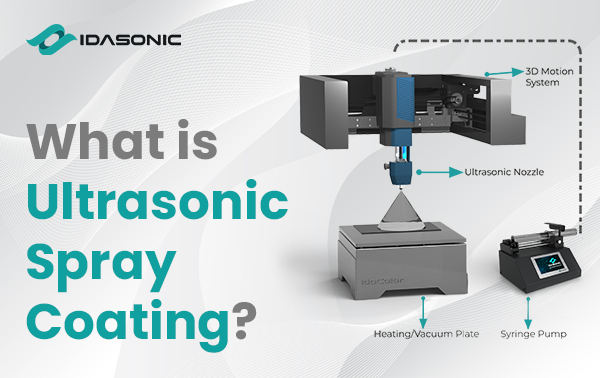
Ultrasonic spray coating is a coating technique that uses high-frequency vibrations to break a liquid solution into a fine mist of uniformly sized droplets. As a result, it enables extremely thin, consistent, and controlled material deposition on various surfaces. Compared to traditional spray methods, it produces less overspray and improves coating efficiency, making it ideal for precision applications in research and industrial manufacturing.
The cost of an ultrasonic spray coating machine varies depending on several factors, including coating area size, automation level, material compatibility, and additional process modules such as heating stages or plasma treatment. Therefore, prices change according to the model and performance requirements.
At Idasonic, we offer high-quality ultrasonic spray coating systems engineered for different budgets and application scales, ensuring that both research labs and large-scale production facilities can access the right solution.
Ultrasonic spray coating can be used to deposit functional, protective, or biological layers onto a wide variety of substrates.
For example, it is commonly used in:
Fuel cells and hydrogen energy systems to apply catalyst layers with precise thickness.
Solar cells and electronics, where uniform conductive coatings are required.
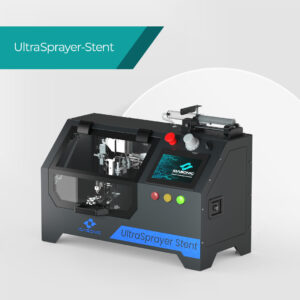
Biomedical applications, such as coating implants, stents, and drug-delivery devices.
Advanced materials research, including hydrophobic, antibacterial, or conductive textile coatings.
Its precision, repeatability, and material efficiency make it appropriate for both research and industrial-scale production.
Ultrasonic spray coating provides several key advantages:
| Benefit | Explanation |
|---|---|
| High Uniformity | Generates evenly distributed droplets for precise and repeatable coating thickness. |
| Material Efficiency | Minimizes overspray, reducing waste and lowering material cost. |
| Low Temperature Application | Suitable for heat-sensitive biological and polymer-based materials. |
| Scalability | Easily adaptable from small laboratory setups to automated production systems. |
| Enhanced Process Control | Allows fine adjustment of droplet size, flow rate, and deposition speed. |
In summary, this method delivers better accuracy, lower waste, and more consistent coating results than conventional spraying techniques.
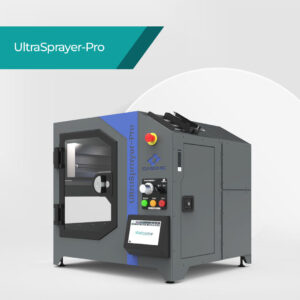
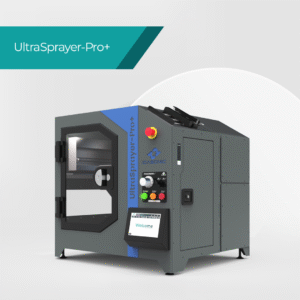
Idasonic provides a complete range of ultrasonic spray coating solutions designed for different application needs:
| Model | Key Application Focus | Description |
|---|---|---|
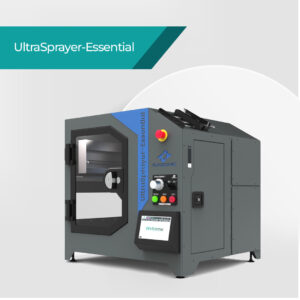
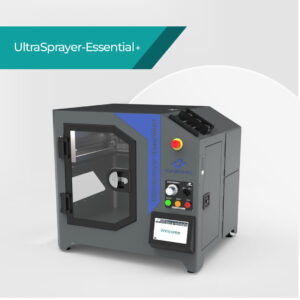
| UltraSprayer® Essential | Research & Prototyping | Ideal for laboratories and small-scale coating development. |
| UltraSprayer® PrecisionLine | High-accuracy Industrial Coatings | Designed for precise, repeatable thin-film coatings in advanced material production. |
| UltraSprayer® ShapeFlex | 3D and Curved Surface Coating | Integrates a 6-axis robotic arm to coat complex geometries with consistent results. |
In addition, customization options are available to match unique process requirements.
Ultrasonic spray coating is used in a broad range of industries where uniform and high-performance coatings are required. Because the process offers precise control and minimal material waste, it is especially valuable in advanced research and production environments.
Energy Technologies: Used to apply catalyst layers in fuel cells, electrolyzers, and battery electrodes, improving efficiency and durability.
Medical and Pharmaceutical: Enables biocompatible and drug-loaded coatings for stents, scaffolds, and implantable devices.
Electronics and Microfabrication: Allows controlled deposition on sensors, flexible circuits, MEMS devices, and semiconductor components.
Textiles and Functional Fabrics: Used to create water-repellent, antibacterial, conductive, or breathable coatings without damaging the fiber structure.
Optics and Coatings Research: Supports the formation of transparent, anti-reflective, or protective thin films in precision optical systems.
Thanks to its versatility and accuracy, ultrasonic spray coating has become a key enabling technology in both innovation and industry-scale production.
Would you like to see our Ultrasonic Spray Coating Machines? Click here.
For company news, product updates and releases, subscribe to our newsletter.
© 2016 IDASONIC: Ultrasonic Spray Coating & Electrospinning Systems
Privacy Policy – Terms and Conditions – Cookie Declaration